






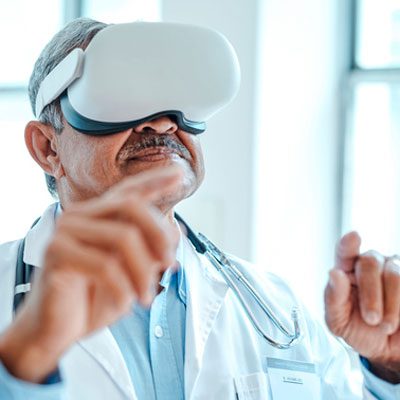
As we observe Patient Safety Week, I am excited to bring focus to technology that has been making a difference in healthcare: virtual reality (VR) for infection prevention and control (IPC). VR is experiencing a rapid increase in adoption in healthcare education as the software has improved, real-time feedback has become more precise and effective, and headsets have become more affordable.
Why we need better infection and prevention control practices
Healthcare-associated infections (HAIs), continue to be a challenge in hospitals, impacting patient safety, increasing healthcare costs, and straining resources. According to the Centers for Disease Control (CDC), 1 in 31 hospital patients contracts an HAI every day. While infection prevention measures such as hand hygiene and proper PPE use are well-known, adherence remains inconsistent, indicating a need for better IPC training.
Traditional infection prevention training relies on lecture-based or online learning, which may not provide real-world application and engagement. Studies have shown that these learning modalities don’t always translate knowledge acquisition into consistent clinical practice. The COVID-19 pandemic further highlighted the need for more effective, scalable, and engaging infection control training.
How VR is transforming IPC education
VR offers immersive, experiential learning opportunities that significantly improve knowledge retention, engagement, and — perhaps most importantly — actual behavior change. Unlike conventional training methods, VR allows healthcare professionals to practice in simulated clinical environments, but without risk to patients.
Key benefits of VR in IPC training
For IPC, we have seen the following benefits:
- Enhanced engagement and retention — Studies show VR training improves hand hygiene adherence by 68% compared to traditional methods.
- Real-time feedback and visualization — VR provides immediate feedback on hand hygiene, contamination risks, and germ spread, helping users develop a mental model of pathogen transmission.
- Scalability and cost-effectiveness — Unlike physical simulation labs, VR allows for repeated practice with no additional material costs.
- Customizable learning paths — VR training can be tailored to different levels of experience, making it ideal for new nurses, experienced clinicians, and interdisciplinary teams.
Psychological and behavioral benefits of VR
Virtual reality enhances learning by leveraging immersive experiences that engage multiple senses, making training more memorable and impactful — and even enjoyable. Studies indicate that VR learners are 275% more confident in applying their skills compared to e-learning. This confidence stems from the ability to repeatedly practice scenarios in a safe, controlled environment, allowing for mistake-driven learning without consequences. Real-time feedback and visual representation of pathogen transmission reinforce behaviors that are crucial for infection prevention, ensuring long-term adherence to evidence-based best practices through improved memory and information recall.
Gamification elements in VR training, such as scoring systems and rewards, further boost engagement. Turning infection prevention into a challenge-based learning experience helps staff retain information better while promoting healthy competition and motivation. The combination of interactive learning and behavioral reinforcement makes VR a superior tool for changing IPC behaviors in healthcare settings.
Relias’ assessment-based learning follows this model. Learners are scored on their ability to follow evidence-based practice. They can then repeat the training and improve their performance using the feedback they receive, safely and without risk.
Cost savings and efficiency of VR in IPC training
Beyond its educational impact, VR training offers significant cost savings and operational efficiencies for hospitals. Traditional infection prevention training often requires instructors, printed materials, physical simulation exercises, lab space, oversight, and consecutive hours of learning, which can be expensive and resource intensive. VR, on the other hand, provides a scalable, portable, and repeatable training model that can be used to provide and refresh clinician learning without additional material costs. The Relias product can be used with or without a wi-fi connection and modestly priced headsets.
Hospitals and health systems will also save money by reducing HAIs, which are estimated to cost the U.S. healthcare system over $40 billion annually. By improving hand hygiene adherence, proper PPE use, and surface decontamination protocols, VR training can substantially lower infection rates, ultimately reducing patient complications, readmissions, and associated costs.
Additionally, VR training sessions are short and efficient, typically lasting only 15-20 minutes, yet deliver high-impact learning outcomes that adhere to CDC and WHO requirements. This efficiency ensures that busy healthcare professionals can complete training without major disruptions to patient care. Clinicians can even complete training at the point of care, enabling them to stay in their units while advancing their learning.
Case studies: How VR improves IPC compliance
Recent pilot programs have demonstrated VR’s effectiveness in improving IPC adherence and reducing HAIs. Each of these pilots used Relias VR for Infection Prevention and Control (IPC) software.
Intermountain Healthcare’s VR IPC pilot
Intermountain Healthcare implemented a VR infection prevention training program across two hospitals, focusing on ICU and IMC nurses. The program started slowly due to its initial voluntary status as nurses faced competing priorities and limited awareness. However, when VR training was integrated into nurse residency programs and skills days, participation significantly improved. The results were encouraging, with nurses demonstrating increased hand hygiene adherence and stronger IPC competency. Many participants provided positive feedback, emphasizing how real-time visual feedback in VR helped reinforce best practices.
Emory University’s VR hand hygiene study
Emory University conducted a study focusing on WHO’s “My Five Moments for Hand Hygiene” framework to evaluate the impact of VR training on nurses’ adherence to IPC protocols. The study revealed that nurses who completed VR training improved their self-efficacy, awareness, and adherence to hand hygiene protocols. Nurses reported feeling more confident in their infection prevention practices, and their hand hygiene compliance rates increased. The study found that VR training does not just provide knowledge but also enhances practical application, ensuring better real-world compliance with IPC measures.
Pediatric VR IPC training pilot
A pediatric VR IPC training pilot was conducted in two U.S. hospitals, involving 63 registered nurses. The training focused on hand hygiene and cross-contamination risks, using interactive VR scenarios. Nurses responded positively, with 98% recommending routine VR training as part of their ongoing education. Many reported that VR provided a new level of awareness about pathogen transmission, making them more mindful of their actions in real clinical settings. This study, which will be published later this year, further confirmed that VR training improves hand hygiene compliance and fosters a stronger commitment to infection prevention.
Real-life testimonials from nurses using VR for IPC
Nurses and healthcare professionals who have participated in VR IPC training programs have reported noticeable improvements in their daily infection prevention practices. In our pilot study with Emory University, 95% of participants agreed that VR is a useful way to learn about IPC, while 86% reported applying their learning to clinical practice.
One nurse from a pilot program shared: “I think this is a great way to train nurses on infection prevention practices, and I have noticed an impact in my care at the bedside.” Another participant emphasized the groundbreaking nature of the training, stating, “It was very eye-opening. Seeing how easily contamination can spread and being able to visualize it was very impactful.”
The hands-on, immersive experience of VR often resonates more than traditional lectures or videos, making it an ideal training tool for healthcare settings, where adherence to IPC measures is critical.
VR training’s role in enhancing patient safety
Incorporating VR into IPC training aligns with patient safety measures that emphasize proactive risk reduction and workforce preparedness. Hospitals that have invested in VR training for infection prevention have seen:
- Lower infection rates and reduced HAIs
- Improved patient outcomes and safety
- Higher adherence to evidence-based IPC protocols
- Increased staff confidence and compliance with infection prevention measures
Overcoming challenges and scaling VR IPC training
With the known advantages of VR training for IPC, how do you expand its use across your organization to maximize the benefits? Scaling VR training requires organizational buy-in and leadership support. Common barriers include lack of funding, competing priorities, and arbitrary limitations on who can participate.
However, the successful pilot programs we’ve seen indicate that making VR training mandatory, integrating it into structured onboarding programs, and providing incentives like CE credits significantly boost engagement.
Key recommendations for large-scale VR implementation
Organizations that are ready to be proactive in the integration of VR into their educational curricula should consider the following action steps:
- Make VR IPC training a required program to ensure consistency and prioritize engagement.
- Integrate VR into nurse residency programs and ongoing skills training to embed evidence-based best practices throughout your organization.
- Expand access by increasing VR headset availability across units and departments.
- Leverage performance tracking and use tactics like gamification to improve compliance and encourage repeated practice.
- Encourage leadership support through data-driven outcomes demonstrating improved patient safety and reduced infection rates.
The future of IPC training is here
VR for infection prevention and control training is no longer experimental — it is a proven tool that enhances compliance, improves safety, and reduces HAIs. To move the needle in patient safety, healthcare leaders must keep pace with today’s technology. Adopting and scaling VR education programs will help maximize patient protection and workforce preparedness.
By implementing VR-based IPC training, hospitals can foster a culture of excellence, significantly reduce HAIs, and enhance patient safety across all care settings. The future of infection prevention education is here — and it’s immersive, interactive, and impactful.

Deploying VR and Digital Learning Modalities for Greater Effectiveness and Better Outcomes
Healthcare organizations can maximize their staff performance and resources by deploying the best tools available for learners using a blend of learning modalities. Meeting individual learning needs with VR and digital learning modalities increases the speed to safe, independent practice and helps achieve better patient outcomes.
Download now →
