



Risk management in healthcare is a critical, enterprise-wide function that directly impacts patient safety, regulatory compliance, financial performance, and organizational reputation. In any organization, risk management is necessary, risk management within the healthcare industry takes on a whole new meaning.
For other industries, the focus is primarily centered around financial impacts. While this is certainly a concern for hospitals and health systems, no other industry is driven by a focus on patient lives. Patients may be harmed or die as a result of failures in care delivery. This fact significantly raises the stakes for hospitals and health systems to ensure risk management in healthcare is an ongoing, strategic priority.
For healthcare executives, effective risk management is not just about avoiding adverse events. It’s is about building resilient systems that reduce liability, improve outcomes, and sustain long-term organizational performance.
Risk management in healthcare: A primer
Risk management in healthcare refers to the systematic process of identifying, analyzing, mitigating, and monitoring risks that can impact patient safety, staff performance, financial stability, and regulatory compliance.
Leading organizations align their programs with enterprise frameworks such as ISO 31000 and COSO ERM, integrating risk management into strategic decision-making at the executive level.
According to the Agency for Healthcare Research and Quality (AHRQ), preventable medical harm continues to be a significant challenge, reinforcing the need for proactive, system-wide risk strategies.
Why risk management in healthcare hatters for hospitals
Although obstetricians/gynecologists represent only 5% of U.S. physicians, they generate 15% of liability claims and 36% of total payments made by medical liability carriers, according to the American Society for Health Care Risk Management (ASHRM).
Additionally, professional liability trends continue to show increasing severity in claims, particularly in high-risk specialties. Labor and delivery-related issues, with an average value over $400,000, remain significantly more severe than many other types of claims.
At the same time, healthcare organizations are managing growing patient volumes, workforce shortages, and rising regulatory complexity. The Joint Commission continues to emphasize the importance of identifying system-level risks that contribute to sentinel events and patient harm.
Not only are the stakes high in terms of volume of patients, but understanding the unique risk factors across departments adds perspective on why organizations must take a comprehensive approach to risk management in healthcare.
Key risk categories in healthcare organizations
For hospital executives, risk management in healthcare must extend beyond clinical events to include:
- Clinical risk: Patient harm, adverse events, misdiagnosis
- Operational risk: Staffing shortages, workflow inefficiencies
- Financial risk: Malpractice claims, reimbursement penalties
- Regulatory risk: Compliance with CMS and accreditation standards
- Cybersecurity risk: Data breaches and ransomware attacks
The Department of Health and Human Services highlights the increasing threat of cyber incidents in healthcare, which can disrupt care delivery and compromise patient data.
High-risk clinical areas: Obstetrics and emergency departments
Obstetrics
Earlier reporting has highlighted the ongoing issues related to maternal mortality in the United States. The United States continues to have one of the highest maternal mortality rates among developed nations, with disparities persisting across populations.
These findings underscore how variation in care, delayed recognition of complications, and communication breakdowns contribute to risk exposure. For executives, this reinforces the need for standardized protocols and continuous competency validation in high-risk specialties.
Emergency department
In this fast-paced environment, clinicians encounter a wide spectrum of conditions—from minor injuries to life-threatening emergencies. Patients may be unconscious or unable to communicate their medical history, increasing the likelihood of diagnostic errors.
A significant portion of malpractice claims continues to stem from delayed diagnoses, improper assessment, and breakdowns in communication. These risks highlight the importance of system-level interventions, including decision support tools and team-based training.
A risk management framework for healthcare organizations
To move from reactive to proactive strategies, healthcare leaders should adopt a structured approach to risk management in healthcare:
1. Identify risks
Start with comprehensive data analysis to understand where risks exist across the organization. Real-time analytics can help pinpoint areas with the greatest impact on patient safety and outcomes.
2. Analyze risks
Evaluate the likelihood and severity of identified risks, including clinical, operational, and financial implications.
3. Mitigate risks
Implement targeted interventions such as standardized protocols, clinical decision support, and workforce training.
4. Monitor and report
Track key performance indicators (KPIs), including adverse event rates, readmissions, and claims data.
5. Educate and improve
High reliability organizations (HROs) prioritize continuous learning and provide healthcare workers with evidence-based education that is accessible and actionable.
What success looks like: Addressing risk within the ED and OB
BETA Healthcare Group (BETA), the largest professional liability insurer of hospitals on the West Coast, provides a compelling example of effective risk management in healthcare.
Starting in 2008, BETA aligned its “Quest for Zero” initiative with Relias to focus on its two highest-risk areas: obstetrics and the emergency department. The initiative aimed to reach zero preventable, unanticipated events resulting in patient harm.
From 2008–2012, BETA experienced greater than a 50% reduction in obstetrics-related claims after implementing targeted education and risk mitigation strategies. This demonstrates how structured, data-driven approaches can significantly reduce risk exposure while improving patient outcomes.
The role of technology and training in healthcare risk management
For more than 20 years, Relias has helped hospitals identify and reduce variation in care while improving patient safety through analytics, provider assessments, and evidence-based education.
Technology plays an increasingly important role in risk management in healthcare by:
- Enabling real-time data insights
- Supporting competency-based training
- Standardizing care delivery
Solutions like Relias OB and Relias ED focus on high-risk scenarios, including obstetrical emergencies, sepsis, high-risk chest pain, and communication breakdowns—areas that are consistently linked to adverse events and liability.
Key metrics healthcare leaders should track
Effective risk management in healthcare requires measurable outcomes. Executives should monitor:
- Adverse event rates
- Hospital-acquired conditions (HACs)
- Readmission rates
- Malpractice claim frequency and severity
- Staff competency and training completion rates
These metrics provide visibility into both current performance and emerging risks.
The future of risk management in healthcare
As healthcare systems evolve, risk management must also adapt. Emerging trends include:
- Predictive analytics to identify risks before events occur
- Integration of artificial intelligence into clinical decision-making
- Increased focus on health equity and population health risks
Organizations that embrace proactive, data-driven risk strategies will be better positioned to reduce harm, control costs, and improve outcomes.
Conclusion
Risk management in healthcare is no longer a siloed function—it is a strategic imperative for hospital and health system leaders.
From high-risk clinical areas like obstetrics and emergency departments to emerging challenges such as maternal mental health and cybersecurity, the scope of risk continues to expand.
By adopting structured frameworks, leveraging data and technology, and prioritizing continuous education, healthcare organizations can reduce liability, improve patient safety, and build more resilient systems of care.

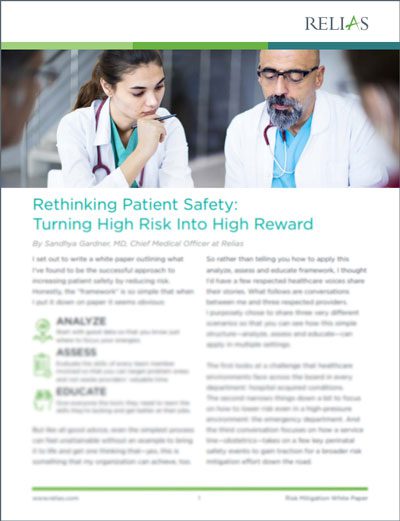
Rethinking Patient Safety: Turning High Risk Into High Reward
The dynamic and evolving healthcare industry is increasing risk for acute care organizations; but, should our focus be on risk mitigation, or patient safety and better outcomes? Download this paper to learn how three respected healthcare providers reduced risk by putting patient safety at the forefront.
Download White Paper →
