






Beginning September 8, 2026, CMS will implement its new Risk-Based Survey (RBS) process nationwide. The approach is designed to recognize higher-performing nursing homes through a more focused standard recertification survey while allowing survey agencies to direct more resources toward facilities where residents may be at greater risk. CMS estimates that approximately 12% of nursing homes will initially qualify.
For nursing home leaders, this is more than a change in how surveys are conducted. It is a reminder that survey readiness does not begin when surveyors arrive. It is built through the systems, processes, education, staffing practices, and leadership decisions that happen every day.
What the new risk-based survey approach means
CMS will determine eligibility for the Risk-Based Survey process quarterly using a set of performance and eligibility criteria. Requirements include a five-star overall rating, at least a three-star staffing rating, accurate data submission, no citations involving actual harm, immediate jeopardy, or substandard quality of care during the applicable survey cycle, and no recent change in ownership. Other criteria include staffing and resident assessment data audits, health inspection performance, staffing waivers, survey timing, and other quality and performance measures.
Qualifying facilities may receive a more focused survey with fewer surveyors and less on-site time. However, they are not exempt from oversight. All nursing homes will continue to receive standard recertification surveys at least every 15 months, and traditional surveys may still be used when concerns about resident health or safety arise.
The message for providers is clear: High performance must be sustained.
My experience as a nursing home administrator taught me that strong survey outcomes are not the result of last-minute preparation. Obtaining a five-star rating requires organizations to build and consistently rely on strong systems that support quality, compliance, accountability, and resident care every day.
The most successful organizations are intentional about understanding their data, identifying risks early, developing their teams, and holding systems accountable.
Ultimately, you cannot manage only for the survey. You have to manage for sustained quality, and survey readiness becomes the outcome of doing that well.
Staying there or getting there
The new CMS model creates two distinct opportunities for nursing home leaders: maintaining strong performance or building the systems needed to get there.
For organizations that qualify, the focus should be on staying there. Maintaining strong performance requires ongoing attention to staffing, quality measures, clinical practices, documentation, competency, compliance, and resident outcomes.
For organizations that do not currently qualify, the criteria provide a roadmap to ask: What systems do we need to strengthen to get there?
That might mean improving staff competency, addressing clinical knowledge gaps, strengthening documentation, improving consistency in policies and procedures, or taking a closer look at quality and staffing data.
Often, what appears to be an isolated compliance issue can point to a larger systems issue. If staff do not understand the process, leaders should ask whether education is the gap. If staff understand the process but do not consistently follow it, leaders should consider whether the issue is related to competency, supervision, or the process itself.
These are the questions leaders should be asking.
How providers can prepare for risk-based surveys
The strongest preparation begins with strong systems, proactive leadership, and a consistent approach to quality and compliance. Education, competency, policies, procedures, and supervision all play an important role in supporting those systems and helping staff understand and consistently meet expectations.
Comprehensive onboarding and ongoing education can help build knowledge, skills, and confidence while addressing emerging risks and keeping staff current as regulations, clinical practices, and resident needs evolve.
Administrators should also use staffing data, quality measures, audits, survey history, incident trends, and other performance indicators to identify risks early. When a concern arises, leaders should look beyond the immediate issue to understand the root cause and determine whether the opportunity is related to education, competency, process, policy, documentation, or oversight.
For organizations that qualify, these systems can help them stay there. For those that do not, they can help build a path to get there. The goal is not simply to prepare for a survey, but to build an organization that is prepared every day.
Beyond survey readiness
The new Risk-Based Survey approach reinforces something many experienced nursing home leaders already know: survey outcomes are often a reflection of the systems operating every day.
Organizations that consistently perform well are not necessarily the ones that react fastest when surveyors arrive. They are the ones that build systems that make the right practices part of everyday work.
For administrators, that means thinking strategically about the connection between people, processes, data, education, competency, and outcomes.
For organizations that qualify, the goal is to stay there.
For those that do not, the goal is to identify what is standing in the way and build a path forward.
Ultimately, the goal is to move beyond being survey-ready and build an organization that is always ready because it is always focused on quality, safety, competency, and the people it serves.

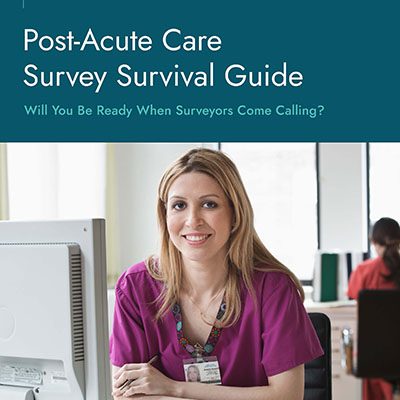
Post-Acute Care Survey Survival Guide: Will You Be Ready When Surveyors Come Calling?
Learn more in our research brief, Post-Acute Care Survey Survival Guide: Will You Be Ready When Surveyors Come Calling?, where we provide: • Insight into what surveyors expect from your facility • Tips to make survey readiness an everyday state • Tactics and techniques to perform a self-audit • Information on how best to organize your data
Download now →
