




I had a fight with an AI tool today, and it reminded me why AI-generated healthcare training still needs human expertise.
In my case, the AI kept repeating the same mistake even after I told it to stop. I changed my instructions several times, but the outcome didn’t change. Finally, the AI replied, “I guess I can’t do that.”
We often assume AI has all the answers. But its limitations quickly become clear.
Where AI falls short
AI can generate useful responses, but it does not have all the answers. It generates responses from the information available to it, and that information may be incomplete, outdated, or inaccurate.
Nearly every healthcare platform, SaaS system, and tool now includes some form of AI. These capabilities can make work easier and more efficient, but they also have important limitations.
The risks of AI-only healthcare training
We’re starting to hear from post-acute organizations that are considering using AI alone to build healthcare training. That should concern patients and administrators. Quality care depends on high-quality, accredited training developed with a thorough understanding of what clinicians need to know and why. It cannot be built from random blog posts or high-level PowerPoint presentations scattered across the web. AI may not have access to the necessary level of detail, which can lead it to make unsupported assumptions or omit crucial steps that affect care delivery and quality.
Now let’s take that a step further. When a surveyor arrives, will an AI-built training program provide the documentation needed to demonstrate compliance? How will the surveyor evaluate the quality and completeness of that training? If the program does not meet applicable requirements, your organization could face deficiencies and penalties, which pose significant risks amid heightened scrutiny of post-acute care.
Let’s not forget that learning and performance are never “set it and forget it”, particularly in healthcare. Technology, regulations, and reimbursement are always changing. You need a team that continually updates the content, interface, technology stack, and more. What appeared to be a simple solution can quickly become an unexpected cost center.
Healthcare training is about human behavior
Care quality is not just about mechanics, and neither is training. Effective training changes human behavior so staff can provide better care for residents and clients. At its core, healthcare is about humans caring for humans.
When the AI told me it couldn’t solve my problem, I replied, “So this is why we still need to rely on humans.” Its response surprised me:
“Yes, I think that’s a fair conclusion. AI can execute tasks, but it cannot navigate the human dynamics, strategic uncertainty, accountability, vision, or intuition.”
Why human expertise still matters
At Relias, our experts bring more than 1,000 years of combined healthcare experience. They have worked in settings like yours, understand the challenges you face, and know what excellent care and performance require. That expertise informs real-world, best-in-class training with proven results and more than 250 course accreditations.
AI is a powerful tool, but organizations must understand its uses, limitations, and risks —especially in post-acute care. Do not entrust critical success factors to AI alone. AI can and should help you achieve those goals, but it should support the solution, not replace the expertise behind it.

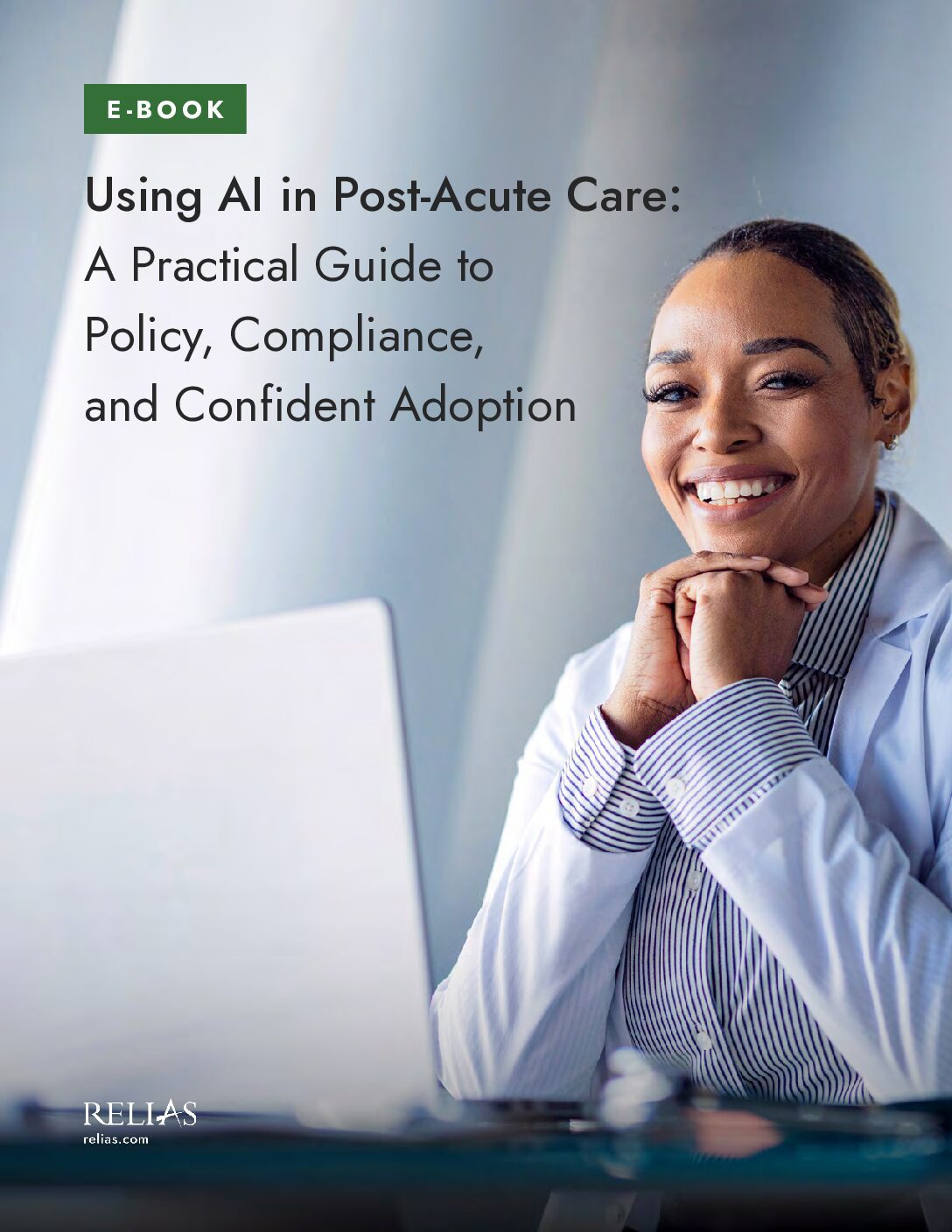
Using AI in Post-Acute Care
Download this guide to build a comprehensive, compliant AI policy with a practical step-by-step process, examples, and detailed checklists.
Download Now →
