






Moral injury in nursing occurs when nurses are repeatedly placed in situations where they cannot provide care aligned with their ethical and professional standards due to system-level constraints.
The alarming rate of burnout among clinicians has brought increased attention to moral injury in nursing. Nurses, who often enter the profession with a strong sense of purpose and commitment to patient care, may experience moral injury when they are unable to ensure that patients receive the care they need. This creates a distressing disconnect between the values that led them into healthcare and the realities of daily practice. Financial pressures, regulatory requirements, and inadequate care models can shift focus away from the patient-clinician relationship, forcing nurses to make compromises that conflict with their core beliefs.
According to the Health Resources and Services Administration’s 2024 National Sample Survey of Registered Nurses, job dissatisfaction among nurses has nearly doubled in recent years. Meanwhile, demand is projected to exceed supply by more than 300,000 RNs by 2036.
The causes of moral injury in nursing
The COVID-19 pandemic placed extreme pressure on the nursing workforce and, in many settings, meant that nurses are confronted daily with morally challenging dilemmas. Indeed, recent articles in both the New England Journal of Medicine and JAMA describe sources of moral injury associated with the pandemic. For example:
- The fear of being unable to protect oneself, one’s patients, and one’s family because of insufficient supplies of personal protective equipment
- Not being able to provide quality care to every severely ill patient
- Taking on roles for which one feels inadequately trained
But a range of factors contributed to moral injury in nursing long before the pandemic and often persist today. Pain points that led to moral injury in nursing consist of:
- Poor team communication
- Lack of staff input into clinical decisions
- Disagreements with physicians about patient care
- Unsafe staffing levels
- Inappropriate use of resources
These challenges are not temporary. Federal workforce projections show nursing shortages are expected to persist for the next decade.
How is moral injury different from burnout?
While burnout and moral injury are closely related, they stem from different underlying causes and require different solutions.
| Burnout | Moral Injury in Nursing |
|---|---|
| Driven by chronic stress, workload, and fatigue | Driven by ethical conflict and inability to provide appropriate care |
| Characterized by emotional exhaustion, depersonalization, and reduced accomplishment | Characterized by guilt, distress, and conflict with professional values |
| Often addressed through resilience, self-care, and workload management | Requires system-level changes in staffing, policies, and care delivery models |
For healthcare leaders, this distinction is critical. Burnout interventions often focus on the individual, while addressing moral injury in nursing requires organizational and operational change.
Impact on healthcare organizations
When nurses find themselves in situations where they feel they cannot live up to their own values, or where their teams are not meeting high standards of care, they may experience guilt, shame, or other negative emotions about themselves. They also may feel devalued and voiceless, which can lead to distrust of colleagues or of the leaders of their organization. Intense feelings of moral injury can contribute to the development of mental health challenges, and the accumulating effect of moral injuries over time can have long-lasting effects on one’s sense of self.
Thus, moral injury in nursing can lead to:
- Increased turnover as nurses leave the organization or the field entirely
- Patient safety issues or poorer quality of care
- Team dysfunction
Why moral injury in nursing is a strategic risk for hospitals
The costs of moral injury speak for themselves. To start, nearly 40% of nurses say they plan on leaving the profession by 2029. And it now costs an $61,000 to replace one RN. That adds up to between $6.6 million and $10.5 million per American hospital each year. Each percent in turnover equals $380,600 per year in savings or costs.
Of course, there is also the ongoing healthcare worker shortage to keep in mind as well. Hospitals remain a major employer for nurses (about half of RNs work in hospitals), so turnover quickly leads to knock-on effects, such as:
- Increased workload
- Greater ethical strain
- Further turnover
And then there is the effect on patients — literally life and death. Nurse staffing shortages are associated with more adverse outcomes, including higher patient mortality. That leads to more burnout, more moral injury, more turnover, and poorer patient safety and satisfaction ratings.
Furthermore, moral injury in nursing is a sign of system-level problems, such as:
- Resource limitations
- Administrative burden
- Poor policy planning and implementation
How healthcare leaders can mitigate moral injury in nursing
For healthcare executives, addressing moral injury in nursing is not a communication exercise, it is an organizational responsibility. Emerging research consistently shows that moral injury is driven less by individual resilience and more by modifiable system-level factors, including leadership support, decision-making structures, and care delivery models.
A growing body of evidence emphasizes that effective responses must operate across multiple levels of the organization (individual, team, and system) with leadership accountability at the center.
1. Strengthen Leadership Visibility and Trust
Perceived lack of leadership support is one of the strongest predictors of moral injury among healthcare workers.
What leaders can do:
- Implement leadership rounding to understand frontline constraints in real time
- Create consistent, transparent communication channels between executives and clinical staff
- Demonstrate alignment between organizational values and operational decisions
Trust is not built through messaging. It is built when staff see that leadership decisions consistently support safe, ethical patient care.
2. Involve Nurses in High-Stakes Decision-Making
Moral injury often occurs when clinicians feel excluded from decisions that directly impact patient care.
Research highlights that involving staff in discussions around policies, workflows, and care constraints can significantly reduce moral distress.
What leaders can do:
- Include nursing representation in operational and ethics committees
- Establish structured forums for frontline input on care delivery challenges
- Incorporate clinician feedback into policy and process redesign
3. Redesign Systems That Create Ethical Conflict
A recent report underscores that moral injury is fundamentally a system-driven issue, often rooted in productivity pressures, administrative burden, and misaligned incentives that prevent clinicians from delivering optimal care.
What leaders can do:
- Evaluate workflows that force tradeoffs between efficiency and care quality
- Reduce non-clinical administrative burden where possible
- Align performance metrics with patient-centered outcomes, not just throughput
Addressing moral injury requires confronting the structural conditions that create it.
4. Build a Culture of Psychological Safety and Team Support
Organizational culture plays a measurable role in moral injury risk. Environments that foster collaboration, peer support, and open dialogue show lower levels of distress.
What leaders can do:
- Support interdisciplinary team communication and debriefing practices
- Train managers to recognize and respond to ethical distress
- Normalize discussion of morally challenging cases without stigma
This shifts the culture from silent endurance to shared problem-solving.
5. Align Organizational Values with Operational Reality
One of the most cited drivers of moral injury is value misalignment—when clinicians feel that organizational priorities conflict with patient care.
Experts emphasize that “morally centered organizations” are those where stated values are consistently reflected in day-to-day operations and incentives.
What leaders can do:
- Audit whether financial and operational policies support or undermine clinical ethics
- Reconcile gaps between mission statements and frontline experience
- Embed ethical decision-making into leadership performance metrics
When values and operations diverge, moral injury becomes inevitable.
FAQs about moral injury in nursing
What is moral injury in nursing?
Moral injury in nursing occurs when nurses are repeatedly placed in situations where they cannot provide care aligned with their professional and ethical standards. This often results from systemic constraints—such as staffing shortages, administrative burden, or policy limitations, rather than individual resilience or coping ability.
What causes moral injury in nursing?
Moral injury in nursing is primarily driven by system-level factors, including:
- Unsafe staffing levels and workforce shortages
- Excessive administrative and documentation requirements
- Limited clinician input into care decisions
- Resource constraints that impact patient care quality
- Misalignment between organizational priorities and clinical ethics
These conditions force nurses to make tradeoffs that conflict with their professional values.
How is moral injury different from burnout?
While burnout is typically associated with emotional exhaustion and workload, moral injury is rooted in ethical conflict.
- Burnout: Caused by chronic stress, overwork, and fatigue
- Moral injury: Caused by being unable to provide appropriate care due to system constraints
For healthcare leaders, this distinction is critical—burnout interventions often focus on individual resilience, while moral injury requires organizational and operational change.
Why should healthcare executives be concerned about moral injury in nursing?
Moral injury is not just a workforce well-being issue, it is a strategic and financial risk.
It is associated with:
- Increased nurse turnover and vacancy rates
- Higher recruitment and onboarding costs
- Reduced patient safety and quality outcomes
- Lower staff engagement and team cohesion
Left unaddressed, moral injury can destabilize workforce sustainability and impact organizational performance.
How does moral injury affect patient care and outcomes?
Moral injury contributes to conditions that directly impact care delivery, including:
- Communication breakdowns among care teams
- Increased likelihood of errors or adverse events
- Reduced patient satisfaction and trust
- Inconsistent care quality due to staffing instability
For hospitals, this creates both clinical and reputational risk.
What can healthcare organizations do to reduce moral injury in nursing?
Effective strategies focus on system-level change rather than individual coping. Key actions include:
- Improving staffing models and workload distribution
- Reducing administrative burden and inefficient workflows
- Involving nurses in decision-making and policy development
- Aligning operational metrics with patient-centered care goals
- Strengthening leadership visibility and trust
Organizations that address these factors see improvements in both workforce stability and care outcomes.
Can moral injury in nursing be prevented?
While not entirely preventable, moral injury can be significantly reduced by designing care environments that support ethical practice.
Prevention depends on:
- Proactive workforce planning
- Leadership accountability
- Continuous evaluation of policies that create ethical strain
- Building a culture where clinicians can raise concerns and influence change
In practice, reducing moral injury requires ongoing alignment between organizational strategy and frontline care realities.
How should healthcare leaders measure and monitor moral injury?
Because moral injury is often underreported, leaders should use a combination of quantitative and qualitative indicators, such as:
- Nurse turnover and retention rates
- Employee engagement and experience survey data
- Reports of ethical concerns or care constraints
- Exit interview insights
- Patient safety and quality metrics
Tracking these signals together provides a more accurate view of underlying system strain.
What is the relationship between moral injury and nurse turnover?
Moral injury is a leading contributor to nurse turnover, particularly when clinicians feel unable to provide safe, high-quality care.
When unresolved, it leads to:
- Disengagement and reduced job satisfaction
- Increased intent to leave the organization or profession
- Loss of experienced staff and institutional knowledge
Addressing moral injury is therefore a key lever in any long-term nurse retention strategy.
Why is moral injury increasing in healthcare?
Moral injury in nursing has intensified due to a combination of structural pressures, including:
- Ongoing workforce shortages
- Rising patient acuity and demand
- Financial constraints and efficiency pressures
- Expanding administrative and regulatory requirements
These forces increase the frequency of ethically challenging situations, making moral injury more prevalent across healthcare settings.

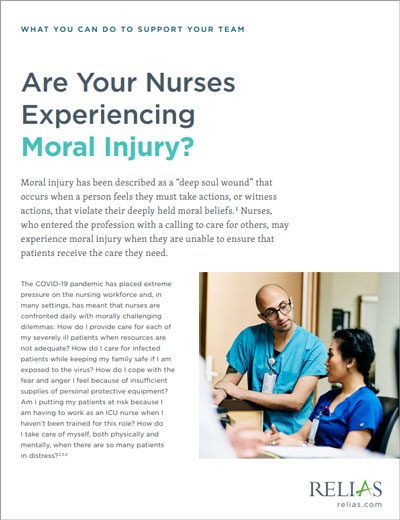
Are Your Nurses Experiencing Moral Injury? What You Can Do to Support Your Team
Download this white paper to learn about seven ways to address moral injury with your team by building connections, including ways to both empower and protect your team members and to enhance both interpersonal and interorganizational communication.
Download White Paper →
