

A continuous learning culture is a workplace environment where employees are consistently encouraged, supported, and empowered to develop new skills, share knowledge, and pursue ongoing professional growth. Organizations that prioritize continuous learning are often more adaptable, innovative, and resilient in the face of workforce changes, technology disruption, and evolving community needs.
According to LinkedIn’s Workplace Learning Report, employees are significantly more likely to stay at organizations that invest in career growth and professional development. Similarly, the World Economic Forum continues to emphasize the growing importance of upskilling and reskilling as industries adapt to rapid workforce transformation.
The benefits of a continuous learning culture
- Enhances employee engagement and retention
- Improves adaptability during periods of change
- Strengthens problem solving and innovation
- Supports leadership development and internal mobility
- Encourages collaboration and knowledge sharing
- Improves resilience during staffing shortages and crises
A Relias DSP Survey found that many direct support professionals are more likely to remain with organizations that offer strong career advancement opportunities and workforce development support.
Research from Gallup also estimates that replacing employees can cost between 50% and 200% of an employee’s annual salary, making learning culture investments strategically valuable for retention.
Reskilling vs. upskilling
Upskilling and reskilling are two great ways to practice continuous learning at your organization.
Upskilling helps employees deepen their expertise within their existing positions, while reskilling prepares employees for entirely new responsibilities or career paths.
| Approach | Definition | Example |
| Upskilling | Improving skills for a current role | A counselor learning advanced suicide prevention techniques |
| Reskilling | Learning new skills for a different role | A DSP transitioning into a supervisory position |
How to build a continuous learning culture
1. Align learning with organizational goals
Organizations should identify the skills employees need both now and in the future. This includes clinical, technical, leadership, communication, and digital competencies.
2. Conduct skills gap analyses
Skills gap assessments help leaders identify where employees need additional development and where future workforce shortages may emerge. Skills gap analysis tools can help organizations better understand workforce readiness and development needs.
3. Personalize learning paths
Employees are more engaged when learning experiences align with their career goals, interests, and responsibilities.
4. Use modern adult learning strategies
Blended learning, microlearning, mentorship, peer coaching, and spaced repetition can significantly improve engagement and knowledge retention. Research on blended learning has shown that adult learners often benefit from combining online and instructor-led education.
5. Leverage learning technology
Learning management platforms can automate training assignments, track learner progress, and support scalable workforce development initiatives. Learning management systems can also support spaced repetition and microlearning initiatives that reinforce long-term retention.
6. Measure learning outcomes
Organizations should regularly evaluate training completion rates, engagement scores, retention metrics, promotion rates, and learner satisfaction.
7. Encourage leadership participation
Leaders play a critical role in reinforcing continuous learning by modeling growth, supporting development opportunities, and recognizing employee progress.
The role of leadership in continuous learning
Leadership support is one of the strongest predictors of a successful learning culture. Employees are more likely to engage in training and development when leaders actively encourage growth, provide mentorship opportunities, recognize employee progress, and create psychological safety around learning and experimentation.
How AI and workforce transformation are changing learning culture
Artificial intelligence, automation, and digital transformation are reshaping workforce expectations across nearly every industry. Organizations increasingly need employees who can adapt quickly, learn new technologies, and continuously update their skill sets. McKinsey & Company research suggests that workforce adaptability and ongoing reskilling will become even more important as AI adoption accelerates.
Real-world examples of continuous learning culture
- Healthcare organizations using mentorship programs to develop future clinical leaders
- Behavioral health teams implementing microlearning modules for compliance and crisis response
- Human services organizations cross-training staff during workforce shortages
- Companies offering tuition reimbursement and leadership development tracks
- Organizations hosting lunch-and-learn sessions and peer coaching workshops
Learning culture metrics and ROI
| Metric | Why it matters |
| Retention rate | Measures workforce stability and employee satisfaction |
| Training completion | Tracks participation and engagement |
| Internal promotions | Shows leadership and career development success |
| Employee engagement | Measures workforce morale and learning adoption |
| Skills assessment scores | Helps identify workforce readiness and growth |
| Learner satisfaction | Measures training quality and effectiveness |
Key takeaways
Building a continuous learning culture requires intentional leadership, workforce development strategies, and long-term investment in employee growth. Organizations that prioritize upskilling, reskilling, mentorship, and adaptive learning technologies are better positioned to improve retention, strengthen resilience, and prepare employees for the future of work.
Frequently Asked Questions
What is a continuous learning culture?
A continuous learning culture is a workplace environment where employees are encouraged to consistently develop new knowledge, skills, and professional capabilities.
Why is continuous learning important in the workplace?
Continuous learning helps organizations improve retention, adaptability, innovation, employee engagement, and long-term workforce resilience.
What is the difference between upskilling and reskilling?
Upskilling improves skills within a current role, while reskilling prepares employees for new roles and responsibilities.
How can organizations measure learning culture success?
Organizations can measure training completion rates, retention, employee engagement, internal promotions, learner satisfaction, and performance improvements.
Artificial intelligence, automation, and digital transformation are reshaping workforce expectations across nearly every industry. Organizations increasingly need employees who can adapt quickly, learn new technologies, and continuously update their skill sets. McKinsey & Company research suggests that workforce adaptability and ongoing reskilling will become even more important as AI adoption accelerates.
Real-world examples of continuous learning culture
- Healthcare organizations using mentorship programs to develop future clinical leaders
- Behavioral health teams implementing microlearning modules for compliance and crisis response
- Human services organizations cross-training staff during workforce shortages
- Companies offering tuition reimbursement and leadership development tracks
- Organizations hosting lunch-and-learn sessions and peer coaching workshops
Learning culture metrics and ROI
| Metric | Why it matters |
| Retention rate | Measures workforce stability and employee satisfaction |
| Training completion | Tracks participation and engagement |
| Internal promotions | Shows leadership and career development success |
| Employee engagement | Measures workforce morale and learning adoption |
| Skills assessment scores | Helps identify workforce readiness and growth |
| Learner satisfaction | Measures training quality and effectiveness |
Key takeaways
Building a continuous learning culture requires intentional leadership, workforce development strategies, and long-term investment in employee growth. Organizations that prioritize upskilling, reskilling, mentorship, and adaptive learning technologies are better positioned to improve retention, strengthen resilience, and prepare employees for the future of work.
Frequently Asked Questions
What is a continuous learning culture?
A continuous learning culture is a workplace environment where employees are encouraged to consistently develop new knowledge, skills, and professional capabilities.
Why is continuous learning important in the workplace?
Continuous learning helps organizations improve retention, adaptability, innovation, employee engagement, and long-term workforce resilience.
What is the difference between upskilling and reskilling?
Upskilling improves skills within a current role, while reskilling prepares employees for new roles and responsibilities.
How can organizations measure learning culture success?
Organizations can measure training completion rates, retention, employee engagement, internal promotions, learner satisfaction, and performance improvements.

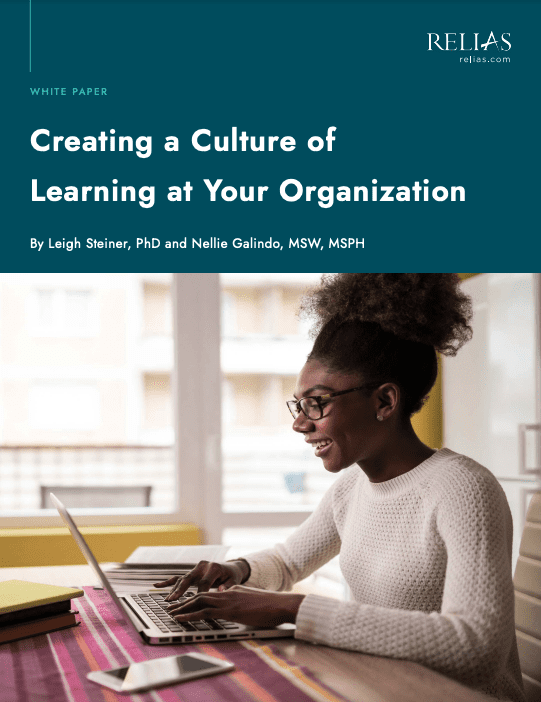
Creating a Culture of Learning at Your Organization
A culture of learning is relevant to any organization. However, the need for healthcare organizations to promote this is critical since evidence-based practices are constantly evolving and your clients’ well-being depends on your staff’s knowledge and skill. In this white paper, you'll learn how to create your own culture of learning.
Download the White Paper →
